STOWAGE & MAINTENANCE MANUAL

Everything secured between stops

An unlashed or poorly stowed paddleboard compromises seamanship. It blocks foresail sheets, obscures helmsman sightlines, and acts as a sail when gusts sweep the deck. Treat stowage as part of securing the vessel for sea.

PASSAGE STOWAGE DECISION TREE

Inflated Deck Lashing vs. Deflated Locker Stowage

Use expected wind strength, passage duration, and point of sail to determine whether boards remain inflated on deck brackets or get rolled into their locker bags:

Passage Condition Recommended Mode Pressure Setting Securing Method
Short Coastal Hop (<5 NM, <12 kt wind, flat sea) Inflated on Coachroof or Rail Cradles Bleed to 10 – 12 PSI Two 25 mm polyester cam straps + secondary bow safety lanyard to padeye.
Upwind Beat or Forecast >15 Knots Deflated & Rolled in Bag 0 PSI (Valve Open During Roll, Closed After) Stowed below decks or wedged low in ventilated cockpit locker away from bilge pumps.
Overnight at Anchor (Forecast Gusts) Inflated Flat on Foredeck or Davits 10 – 12 PSI Inverted (EVA deck pad down out of morning sun/dew) lashed across four deck points.
End of Charter / Multi-Week Layup Freshwater Rinsed, Dried & Loosely Folded 0 PSI Stored in breathable mesh bag in cool dry cabin at 15–25°C away from battery boxes.
DECK LASHING MECHANICS

Why Stanchion Wires Are Not Lashing Points

Plastic-coated or bare 1x19 stainless lifeline wires are engineered to arrest a crew member falling inboard/outboard, not to bear the continuous cyclic wind-load of a 3.5-meter airfoil pounding into head seas. Lashing a board high on the top lifeline exerts massive leverage on the 8 mm bolts securing the stanchion bases to the toe-rail, leading to gelcoat crazing and deck-core water ingress.

Instead, pass flat polyester webbing straps directly around the forged base of the stanchions, through dedicated aluminum toe-rail slots, or onto clamp-on 25 mm stainless rail cradles mounted on the rigid aft pushpit tubing.
THERMODYNAMICS ON DECK

Managing Boyle's & Gay-Lussac's Law in Direct Sun

Air sealed inside a dark-colored PVC board heated from 18°C sea temperature to 55°C on a Mediterranean deck increases in absolute pressure by roughly 12% to 15%, while the thermoplastic polyurethane adhesives holding the rail seams together soften above 60°C.

Water Temp Inflation (18°C) 15.0 PSI
Unvented Midday Deck Peak (55°C) ~18.5+ PSI (Glue Softening Zone)
Safe Deck Standby Pressure 10.0 – 11.5 PSI

Depress the Halkey-Roberts pin for three quick two-second bursts as soon as the board comes out of the water onto the deck.

DEFLATION & LOCKER CARE

Rolling, Salt Removal & Valve Maintenance

Salt crystals left inside a folded board act like coarse sandpaper when the bag vibrates against a yacht bulkhead under engine power.

FOLDING SEQUENCE

Preventing Fin-Box Kinks & Valve Creases

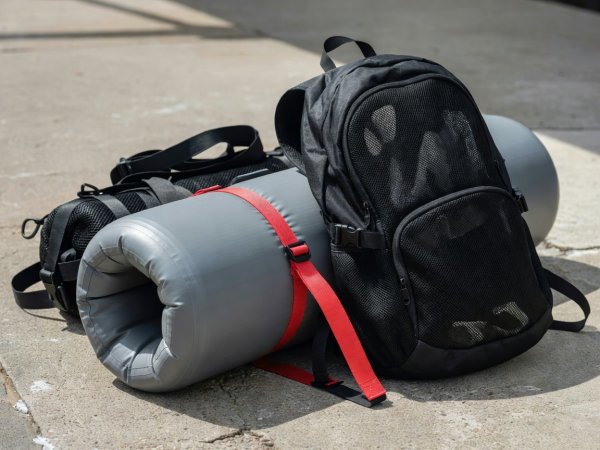
Close-up photograph of a tightly rolled inflatable paddleboard secured with a crimson compression strap beside a ventilated black mesh stowage backpack
FIG 2.1: Rolled hull cinched with wide compression webbing before placing inside a ventilated mesh deck bag.

Always dry the area immediately around the inflation valve with a clean microfiber cloth before opening the cap. Push and twist the valve pin 90 degrees counter-clockwise to lock it open. Fold the board from the nose (bow) toward the tail in 35 cm sections so trapped air is forced cleanly out the stern valve, then return the pin to the closed upright position and cap it so grit cannot enter the silicone seal.

HARDWARE PRESERVATION

Treating Paddles, Fin Boxes & Pump Hoses

  • [A] Separate Paddle Shafts Immediately: Never stow a 3-piece carbon or fiberglass paddle assembled. Saltwater drying inside the tight telescopic joint cements the halves together within 48 hours.
  • [B] Captive Fin Thumbscrews: Screw the brass plate and stainless thumbscrew back into the empty US fin box slot after removing the fin so the small parts cannot roll into a cockpit scupper.
  • [C] Pump Gauge & Hose Protection: Detach the corrugated inflation hose from the pump body before stowing; bending the hose sharply at the gauge manifold cracks the polycarbonate collar.

EXPLORE CALM-WATER ANCHORAGES