DECKSIDE TRANSFER MANUAL

From suitable deck to calm water

Most onboard SUP mishaps occur within two meters of the yacht hull during the transition from deck to board. High freeboard, rolling wakes, and unsecured painters can separate a paddler from their craft in seconds. Assess vessel suitability honestly before launching.

VESSEL SUITABILITY ASSESSMENT

When a Yacht Is — and Is Not — Suitable for Direct Launching

Never assume that because a board fits on deck, the yacht is configured for water-sports deployment. Evaluate the hull profile against these three structural categories before committing anyone to the water:

CATEGORY A // DIRECT ACCESS

Fold-Down Transom & Catamaran Bridge

Modern cruising monohulls with drop-down bathing platforms and twin-hull catamarans with wide sugar-scoop steps placed 15–25 cm above the waterline allow seated or kneeling transfers directly onto the board center handle.

CATEGORY B // ASSISTED TRANSFER

Counter Sterns with Side Boarding Ladders

Classic yachts with 1.2 m+ freeboard require deploying an amidships accommodation ladder or launching via an inflated RIB tender tied alongside as an intermediate floating pontoon.

CATEGORY C // DO NOT LAUNCH

Exposed Sterns in Surge or Unladdered Hulls

If vertical wave surge at the stern exceeds 30 cm—causing a lowered swim platform to slam repeatedly into the trough—or if no rigid re-boarding ladder reaches deep underwater, cancel the launch immediately.

PAINTER & LINE MANAGEMENT

Controlling the Board Alongside

An unencumbered inflatable SUP sitting flat on the water has high windage and virtually zero lateral resistance. If dropped over the rail untethered in a 10-knot breeze, it will drift leeward faster than a swimmer in a buoyancy aid can sprint.

  • Bow Painter Rule: Attach a 4-meter floating polypropylene painter line (8 mm diameter) with a stainless carabiner to the bow D-ring before lowering the board over the rail.
  • Fin-First Orientation: Lower the tail into the water with the fin pointing away from the yacht hull so a sudden roll does not snap the fin box against the transom lip.
  • Paddle Placement: Never toss the paddle onto the floating board before boarding. Hold the paddle shaft in one hand or have a deck helper hand it down once you are stable on your knees.
TRANSFER MECHANICS

The Three-Point Kneeling Mount

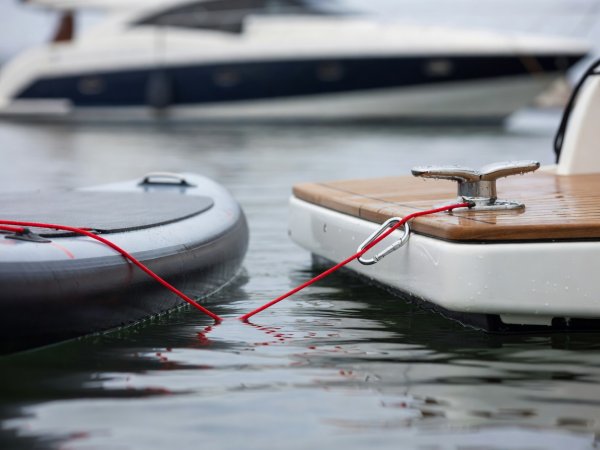
Close-up shallow depth of field photo of a floating red line clipped to a stainless steel D-ring on a paddleboard beside a wet yacht swim platform
FIG 1.1: Floating painter clipped to bow D-ring and snubbed lightly on a stern cleat during transfer. Illustrative example only; release painter cleanly once seated.
  1. Sit on the wet swim platform with feet resting on the submerged ladder rung.
  2. Pull the board parallel to the platform using the center carry handle; attach your leash cuff or waist belt now.
  3. Place your paddle shaft perpendicular across the board just forward of the center handle, pinning it under your palms.
  4. Slide your chest and one knee onto the geometric center over the carry handle, keeping your center of gravity low until you have paddled two boat lengths clear of the yacht's hull and rudder.
RECOVERY & EMERGENCY RE-ENTRY

Deep-Water Remounting & Stern Recovery

Every paddler leaving a yacht must demonstrate a self-rescue remount in deep water without touching the vessel ladder before venturing beyond 50 meters.

DEEP-WATER SELF-RESCUE

Flipping & Mounting an Inverted Board

If wind catches the rail after a fall and flips the board fin-up, reach across the hull width from the windward side to grab the far rail and pull it toward you. To remount in deep water, hold the center handle with one hand and the far rail with the other, kick your legs to the surface horizontally (frog-kick), and slide your hips across the centerline rather than pulling vertically down on one side rail.

RETURNING TO THE VESSEL

Approaching the Leeward Quarter

Always return to the yacht's leeward or down-current side so wind and tide do not pin you under the flare of the bow or across the anchor chain. Drop to your knees 10 meters out, pass the bow painter up to the cockpit watch or clip it to the ladder stanchion, unfasten your leash, and step onto the boarding ladder before lifting the lightweight hull out of the water.

NEXT: ONBOARD STOWAGE MANUAL