EQUIPMENT SPECIFICATION MANUAL

Choosing a board for life aboard

A paddleboard that performs well from a beach car park can prove awkward and fragile aboard a yacht. Salt spray, stainless-steel deck hardware, hot teak surfaces, and restrictive locker hatches demand specific hull materials, split fin boxes, and corrosion-resistant fittings.

PRIMARY SELECTION MATRIX

Evaluating Hull Geometry Against Locker Volume

Before comparing graphics or speed claims, measure the clear opening of your lazarette hatch or under-bunk stowage space with a steel tape. Standard one-piece US fin boxes dictate a minimum folded width of 85 to 92 cm. Boards equipped with a split two-part fin box fold along the longitudinal centerline, cutting bundle width in half.

Hull Class Dimensions (L × W × T) Inflated Volume Deflated Bundle Size Best Onboard Application
Compact All-Round 9'6" × 32" × 4.7" (120 mm) 225 L 45 × 38 × 26 cm (Split Box) Pocket cruisers under 36 ft; lighter paddlers (<80 kg); short harbour hops.
Stable Cruiser 10'8" × 34" × 6.0" (150 mm) 315 L 90 × 44 × 25 cm Stepping off rolling swim platforms; carrying a dry bag of provisions ashore.
Coastal Touring 11'6" × 31" × 6.0" (150 mm) 330 L 92 × 45 × 28 cm Tracking straight across larger bays and tidal estuaries up to 2.5 NM.
Dual-Chamber Expedition 12'6" × 30" × 6.0" (150 mm) 355 L 96 × 48 × 32 cm Catamarans and motor yachts over 48 ft with dedicated transom garages.
LAMINATE TECHNOLOGY

Woven Fusion vs. Knitted Single-Layer PVC

Entry-level single-layer knitted drop-stitch boards flex noticeably in choppy yacht wakes and abrade easily when dragged over barnacle-encrusted slipways or non-skid fiberglass decks. Look for heat-laminated (fusion) woven drop-stitch cores reinforced with double-layer 1000-denier rail bands.

Woven drop-stitch replaces knitted polyester base cloth with a taut grid weave that holds 18 to 20 PSI while reducing overall board weight by 1.8 to 2.5 kg—a crucial advantage when lifting a wet board up over high topsides by a painter line.
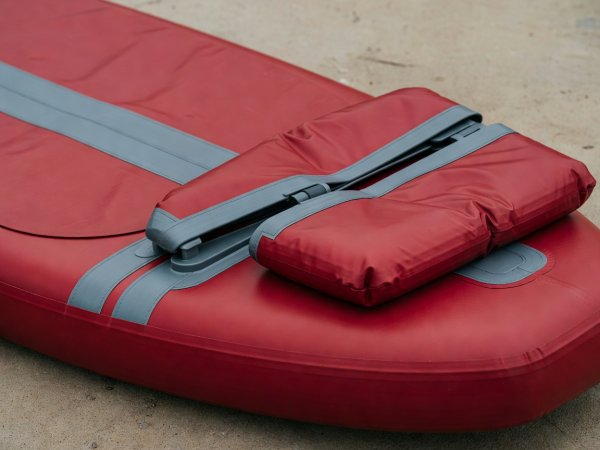
Close-up photograph of a deflated crimson and grey inflatable paddleboard showing the hinged split US fin box and double-layer rail tape
FIG 1.1: Split fin box hinge allowing tight folding without kinking the polycarbonate fin slot. Illustrative equipment detail.
DECK HARDWARE & RUBBING STRAKES

Fender-Effect Rails & Stainless D-Rings

When an inflatable SUP rests alongside a yacht hull during boarding, it acts like an elongated pneumatic fender. However, dark-pigmented cheap PVC can leave stubborn rub marks on white gelcoat or painted topsides. Select boards with non-marking light grey or reinforced TPU rail bumpers.

D-Ring Metallurgy AISI 316 Marine Stainless Steel
Under-Bow Towing Eye Quad-Layer Patch with Webbing Loop
Deck Pad Grooving Diamond-Cut Closed-Cell EVA Foam
Grab Handles Center, Bow & Stern Neoprene Tubular

Insist on stern and bow grab handles in addition to the center carry handle. A swimmer in the water needs a low-profile stern handle to control the board while a crew member on the swim platform reaches for the bow toggle.

COMPACT AUXILIARY HARDWARE

Paddles, Pumps, Leashes & Snorkel Kits

Every piece of auxiliary gear stored on a yacht must justify its cubic volume, resist salt seizure, and either float positively or tether securely.

PROPULSION & TETHERS

Positive-Buoyancy Shafts & Quick-Release Belts

Standard three-piece aluminum paddles fill with water through the adjustment pinholes and sink once the internal air pocket escapes after 20 seconds. On a yacht, specify a 50% to 100% carbon-composite shaft with sealed high-density foam cores in both the blade section and upper T-grip extension.

For leashes, match the cord geometry to the anchorage:

  • Coiled 10 ft Ankle/Calf Leash: Stays on the deck pad out of the water in calm, non-tidal bays so it cannot snag on submerged mooring risers or rocky lobster pots.
  • Quick-Release Waist Belt: Essential whenever paddling in tidal rivers, estuaries, or anchorages with >0.5 knots of current. If swept against an anchor rode or bridge pier, an ankle leash can become unreachable under tension, whereas a chest-height toggle releases instantly.
INFLATION LOGISTICS

Dual-Stage 12V Pumps & Acoustic Etiquette

High-pressure 12V diaphragm pumps shrill loudly in quiet morning anchorages when stage two kicks in above 2 PSI. To keep peace with neighboring yachts:

  • Use a quiet high-volume electric blower (or the dinghy foot pump) to bring the hull to shape (1.5 PSI) inside 60 seconds.
  • Finish the remaining 1.5 to 15 PSI with a dual-action triple-chamber manual hand pump (roughly 90 to 120 strokes), which produces zero mechanical noise.
  • If using a high-draw 12V electric SUP pump (up to 15 Amps), connect directly to heavy-gauge battery terminals or a dedicated cockpit 20A socket rather than a light 10A cabin cigarette outlet to avoid blowing panel fuses.

PROCEED TO LAUNCH PROTOCOLS